Your First Meet
If you have been training and wondering whether you are “ready,” you probably are. Your first meet is not about winning. It is about stepping on the platform, hearing the commands, and walking away with a total and a story.
This page walks you through the whole thing, from signing up to the last deadlift.
Step 1
Pick a meet and register
- Choose a meet on our Upcoming Meets page. A local meet is best for your first time.
- Buy your APF or AAPF membership online through the WPC. Do this before weigh-in, because it may not be sold at the meet.
- Register through the meet’s link.
- Watch your email for the weigh-in schedule and designated flights.
What you will choose
- Tested (AAPF) or untested (APF).
- Event / Category: Full power (all three lifts), push-pull (bench and deadlift), bench only or deadlift only. Check your designated meet to see which events are offered.
- Equipment: Raw or Classic Raw is the easy choice for beginners.
- Division: Your age group, Open, or both.
- Weight class: Your expected weight class based on your bodyweight. Your weight class will be confirmed at weigh-in.
Step 2
Get your gear together
You do not need much. Refer to the rule book for full details.
Required
- Singlet (one-piece, legs no longer than mid-thigh)
- T-shirt for squat and bench
- Shoes (anything sturdier than socks, no metal spikes)
- Long socks that cover your shins for deadlift
- Membership card
Optional
- Lifting belt and wrist wraps (allowed in all categories)
- Knee sleeves or knee wraps (allowed in Classic Raw)
- Chalk or baby powder
Not allowed
- Hats (beanies are allowed at state and local APF meets)
- Lotions or oils on your legs for deadlift
- More than one suit or shirt
Bring for the day
Food you already know agrees with you, water, a sweatshirt for between flights, a towel, a phone charger, and a printout of your planned attempts.
Step 3
Weigh-in, usually the day before
Weigh-ins generally start 24 hours before your session.
- Wear or bring the gear you will lift in. A volunteer will help you set and record your squat and bench rack heights.
- Fill out your lifter card and write down your opening attempt for each lift.
- You step on the scale privately, with an official of the same sex.
- If you are over your class, you can come back to re-weigh during the weigh-in window, or move up a class.
Then go home.
Eat, hydrate and sleep.
Step 4
Meet day, step by step
Expect to be at the venue for most of the day. Pack food like you mean it.
Arrive early
Doors open about 60-90 minutes before lifting starts. Check in and find your flight on the board.
Rules briefing
A referee goes over the commands. First-timers, sit up front. Ask anything.
Your flight
You lift with a group of roughly 10-12 people. Everyone takes a first attempt, lightest to heaviest, then a second, then a third.
Warm up
Start in the warm-up room while the flight before yours is lifting.
Your attempt
The announcer calls your name and you have one minute to start. Loaders and spotters set the bar and stand by for safety.
Hand in your next attempt
You have one minute after each lift to submit your next weight at the table.
Repeat
Squat, then bench, then deadlift, with a short break between lifts.
Awards
Medals typically go to the top three in each class and division.
Step 5
The commands, in plain language
Three referees judge every lift. Wait for each command, then look up at the lights.
Lift | Start command | What you do | Finish command |
|---|---|---|---|
Squat | “Squat” (with a downward arm signal) | Walk the bar out, stand still with knees locked, wait for the command, then squat until the crease of your hip goes below the top of your knee and stand back up. | “Rack” |
Bench | “Press” | Take the bar at arm’s length, lower it to your chest, hold it still, wait for the command, then press to straight arms. | “Rack” |
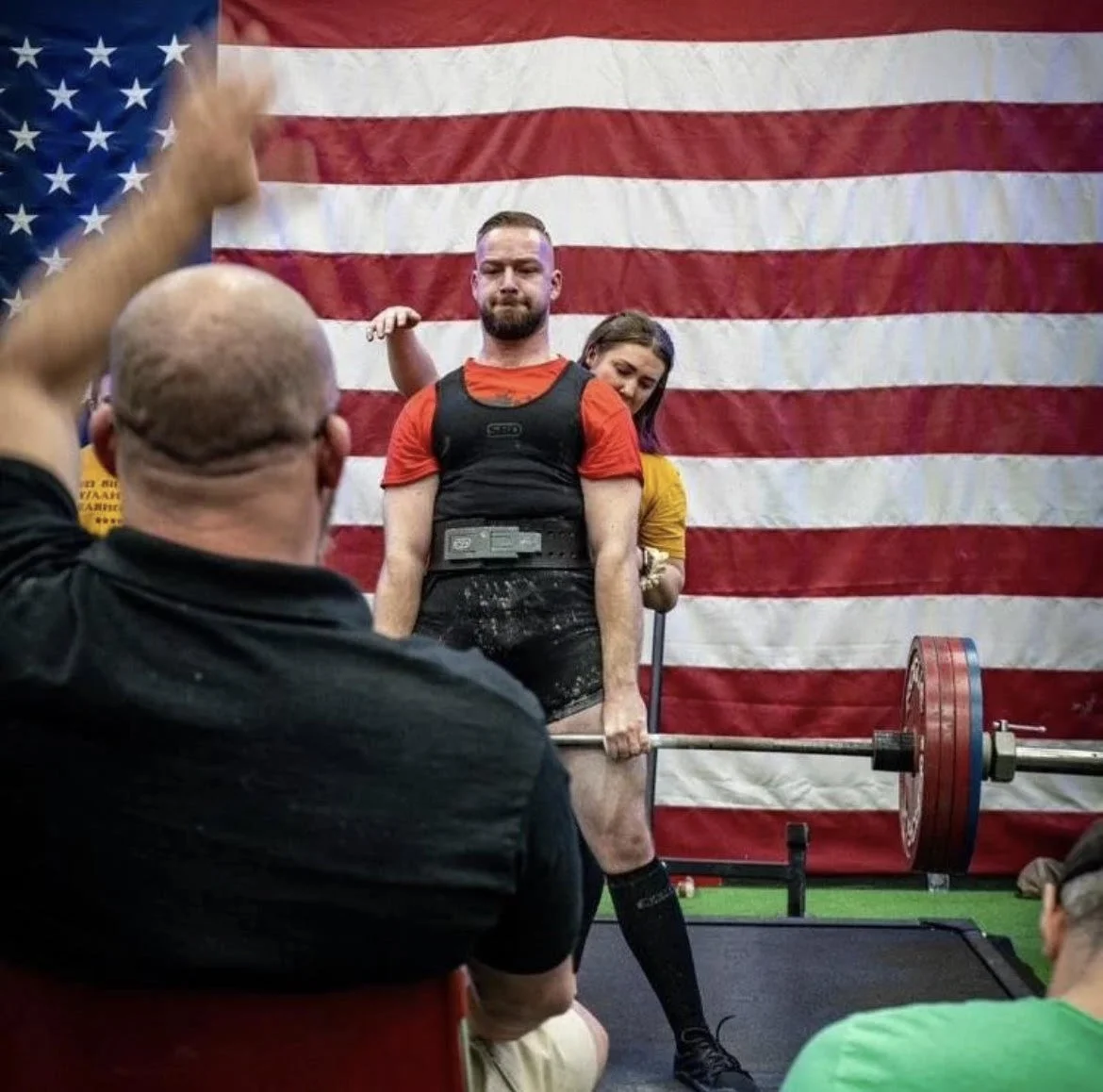
Deadlift | None, start when ready | Pull until you are standing tall with knees and hips locked. | “Down” |
The lights
Each referee shows white (good lift) or red (no lift). Two or three whites and the lift counts.
Most common reasons first-timers get a red light
- Racking the bar or lowering the deadlift before the command
- Not squatting deep enough
- Moving your feet during the squat or deadlift
- Lifting your hips off the bench or bouncing the bar on your chest
- Pressing before the “Press” command
- Letting the deadlift bar drop instead of lowering it with both hands
A red light is information, not failure. Most lifters get at least one.
Step 6
Picking your attempts
Three misses on one lift means no total, so start light, especially on squat. You can retry a missed weight, but never drop below it.
Opener
A weight you could lift on your worst day. For most lifters that is about 90% of their best gym single, a weight they have hit many times.
Second
A solid, confident lift, often close to your current best.
Third
A small personal record if the day is going well, or a safe repeat if it is not.
Your goal for your first meet is simple: get a total.
Step 7
Ease your nerves
Everyone in the room remembers their first meet. People cheer just as loudly for a 135 lb opener as for a 600 lb third attempt.
The referees want you to succeed. If you are unsure about a rule, ask them at weigh-in or during the rules briefing.
You do not need special gear, a coach, or a team shirt.
Nervous energy is normal. Eat, breathe, and listen for the commands.
Make a total, learn something, come back stronger.
Ready?
Still have questions? Email [email protected] or message us on social media.